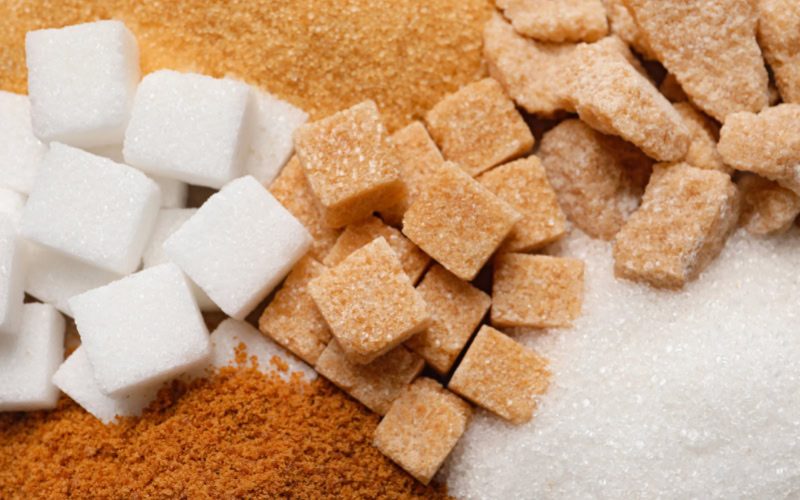
An informative article with details about sugar.
Sugar is classified as an organic compound. There are both inorganic and organic compounds.
Organic compounds are usually characterised by being predominantly composed of carbon and hydrogen atoms. They are stabilised by covalent bonds.
Of course, there are exceptions among organic compounds, as well as inorganic compounds containing carbon, such as carbon dioxide or carbon monoxide. Otherwise, inorganic compounds are typically understood to be substances like water, salts, acids, and bases.
Both types are necessary for metabolism and are found almost everywhere and at all times.
Carbohydrates
Carbohydrates are formed in green plants during photosynthesis from carbon dioxide and water. Sunlight is stored as chemical energy in carbohydrates and is available to all living organisms.
Carbohydrates consist of the elements carbon, hydrogen, and oxygen. In the human body, carbohydrates primarily serve as a rapidly available energy source. Carbohydrates are classified by their chain length into monosaccharides, disaccharides, and polysaccharides.
Role. Carbohydrates are divided by their size into monosaccharides, disaccharides, and polysaccharides.
Monosaccharides
Monosaccharides (mono = one, saccharides = sugar) are simple, ring-shaped sugar molecules. The most important simple sugar in the human body is glucose (grape sugar, dextrose). Glucose can be used by most cells for energy production. Therefore, glucose is the most important energy carrier in the human body. Other common monosaccharides are fructose (fruit sugar) and galactose.
Disaccharides
When two simple sugars react with each other, a double sugar (di = two) is formed. Cane or beet sugar (sucrose) is made from glucose and fructose, while milk sugar (lactose) is made from glucose and galactose. Disaccharides can be split back into simple sugars.
Polysaccharides
Some disaccharides can combine with additional simple sugars to form polysaccharides ("complex sugars"). This results in very large molecules, known as macromolecules. An example of this is starch (amylose). It represents the plant storage form of glucose produced by photosynthesis. Potatoes, corn, and wheat contain particularly high amounts of starch.
When a person eats a starchy meal, the starch is broken down again in the digestive tract. It is split into smaller fragments. This process produces glucose again, which is then absorbed into the bloodstream. When a person consumes a starchy meal, the starch is broken down again in the digestive tract into small fragments. This process produces glucose again, which is absorbed into the bloodstream.
Energy production from glucose
As a "fuel" for essential energy production, most human cells prefer glucose. The main steps of energy production are therefore illustrated by the breakdown of glucose.
The breakdown of glucose can be divided into four steps:
1. Glycolysis – energy production without oxygen.
Glycolysis encompasses numerous enzymatic reactions.
In this process, a glucose molecule is ultimately broken down into two molecules of pyruvate (pyruvic acid). The immediate energy yield of this reaction chain is low: two ATP are produced per glucose molecule. On the other hand, glycolysis, which occurs in the cytoplasm, has the advantage that cells can generate energy even without oxygen.
In the absence of oxygen, skeletal muscle cells, in particular, cannot further break down pyruvate. It is converted into lactate (= lactic acid) and transported to the liver via the bloodstream. Interestingly, heart muscle cells can meet part of their energy needs from lactate during intense exertion.
ATP stands for adenosine triphosphate. ATP is the most important energy-rich compound within the cell. It is a substance found in all living organisms that serves as an energy source for many metabolic processes. ATP is formed from adenosine diphosphate (ADP) during energy-generating processes.
2. Acetyl-Coenzyme A – the central molecule of energy metabolism
With sufficient oxygen supply, pyruvate, the end product of glycolysis, enters the mitochondrion and reacts with coenzyme A to form acetyl-coenzyme A, or acetyl-CoA for short. Acetyl-coenzyme A is a crucial molecule in the entire energy metabolism.
With enough oxygen, the glycolytic end product pyruvate enters the mitochondrion and combines with coenzyme A, or CoA-SH, the active form of pantothenic acid, to form acetyl-coenzyme A, or acetyl-CoA. Although no ATP is produced directly in this process, the NADH formed, the reduced form of NAD (nicotinamide adenine dinucleotide), can later be used to generate energy in the respiratory chain.
3. The citric acid cycle
The citric acid cycle is the next series of enzyme-controlled reactions that occur in mitochondria.
For each acetyl-CoA that enters, an energy-rich phosphate (guanosine triphosphate, or GTP) is produced, which can directly convert ADP to ATP. Additionally, the reduced coenzymes NADH and FADH2 (FAD = flavin adenine dinucleotide) are produced, which are only utilised in the respiratory chain (details on oxidation and reduction below).
However, the citric acid cycle is not only important for glucose breakdown. Many catabolic metabolic pathways feed into the citric acid cycle indirectly or directly, and at the same time, the citric acid cycle provides starting substrates for numerous anabolic metabolic reactions. It is therefore rightly referred to as the "hub" of metabolism.
4. The respiratory chain
In the previously described phases of glucose breakdown, reduction reactions bind electrons to coenzymes. The respiratory chain, or electron transport chain, subsequently transfers these electrons to oxygen. This process produces water and large amounts of energy, which are used to regenerate ATP.
Step by step, a total of 36 ATP molecules are produced from one glucose molecule.
"Regeneration of ATP" refers to the process where ADP is linked with phosphate, i.e., phosphorylated. The respiratory chain and ATP phosphorylation are directly coupled, hence the term oxidative phosphorylation. During the respiratory chain, the electrons from NADH and FADH2 do not go directly to oxygen. Instead, they are sequentially taken up and passed on by enzymes and coenzymes. In this way, the 36 ATP molecules are also produced step by step.
The oxidative breakdown, that is, breakdown with oxygen, of carbohydrates and fats provides energy. This energy-generating process of oxidative breakdown is collectively referred to as cellular respiration. For glucose, the following balance is achieved, for example:
Glucose + 36 ADP + 36 P + 6 O2 " 6 CO2 + 6 H2O + 36 glycogen, or correctly ATP.
If the human body is sufficiently supplied with glucose, it can store it as glycogen. Human glycogen and plant starch are similarly structured and consist solely of glucose chains. Glycogen is mainly stored in the liver and skeletal muscles.
An adult can store a total of about 400 g of glycogen, equivalent to approximately 2000 kcal. About 150 g are found in the liver and roughly 250 g in the muscles. If additional carbohydrates are consumed, for example, through constant consumption of sweets, an excess occurs. This excess glucose is converted into fat and deposited in the liver and adipose tissue. The person gains body weight, and the liver becomes fatty.
Gluconeogenesis (formation of new glucose)
The brain and erythrocytes can only use glucose for energy production. Additionally, glucose is the only substance that skeletal muscles can use for energy production during oxygen deficiency. Gluconeogenesis, the formation of glucose from non-carbohydrate precursors such as certain amino acids, glycerol, or lactate, ensures adequate glucose levels even without food intake and when glycogen stores are depleted.
Gluconeogenesis can be considered the reverse process of glycolysis.
However, gluconeogenesis only occurs with energy consumption, i.e., using ATP.
About 90% of gluconeogenesis occurs in the liver, approximately 10% in the renal cortex.
Sugar in everyday life
Sugar is considered by many to be a quick energy source and mood enhancer. By releasing insulin, it temporarily promotes serotonin production in the brain, thereby improving well-being. However, this positive effect is only short-lived. Subsequently, a rapid drop in blood sugar often follows, leading to fatigue, concentration problems, nervousness, or cravings – the well-known "sugar blues". Particularly critical is the consumption of table sugar in sweets, soft drinks, and refined flours, which lack natural accompanying substances such as fibre, vitamins, and minerals.
Studies show that high sugar consumption not only increases the risk of cavities but is also associated with obesity, diabetes, and cardiovascular diseases. The risk of premature mortality also rises. The brain can also be affected: memory and cognitive performance may decline, and in children, links to hyperactivity and neurocognitive deficits are discussed. Additionally, strong fluctuations in blood sugar levels can weaken the immune system and increase susceptibility to infections.
However, not all sugar is the same. Natural sugar from fruits or whole foods is "buffered" by fibre and micronutrients. This causes blood sugar levels to rise more slowly and in a more controlled manner. Table sugar, on the other hand – a mixture of glucose and fructose – often enters the body in large amounts and without protective accompanying substances. This promotes strong blood sugar spikes, high insulin release, hypoglycaemia phases, and long-term metabolic disorders. Excess fructose is also easily converted into fat and can promote elevated blood fat levels and a fatty liver.