An informative article about fats and enzymes.
Fats and fat-like compounds
Based on their natural occurrence, fats are classified as animal or plant-based:
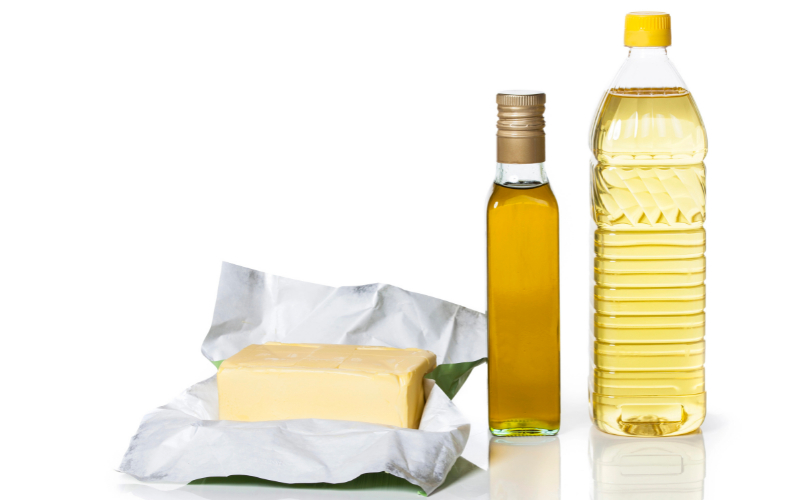
Animal fats include lard, cream, and butterfat. Additionally, all meat and sausage products contain about 5–45% "hidden" fat. Plant-based fats include olive oil, sunflower oil, coconut fat, and wheat germ oil. At room temperature, fats can be liquid or solid; the liquid fats are referred to as (culinary) oils.
Neutral fats (triglycerides)
The largest group of natural fats consists of mixtures of so-called triglycerides, also known as neutral fats.
Tri = 3; each triglyceride consists of a glycerol molecule and three fatty acid molecules.
The human body stores fat as triglycerides in the cytoplasm of fat cells. The biological purpose of this storage form is to provide a large energy reserve for "hard times": fats provide more than twice the energy of carbohydrates (9.3 kcal per gram compared to 4.1 kcal).
A person weighing 70 kg with 11 kg of fat reserves has about 100,000 kcal (!) in the form of triglycerides.
Additionally, adipose tissue, especially subcutaneous fat, serves insulation and protection functions.
Fatty acids are long hydrocarbon chains, usually with 16 or 18 carbon atoms. Depending on whether the carbon skeleton of the fatty acids has double bonds, they are classified as
- saturated fatty acids: they have only single bonds,
- monounsaturated fatty acids: they have one double bond; and
- polyunsaturated fatty acids: with two, three, or more double bonds.
Fatty acids can be ingested through food or produced by the cells themselves, although only one double bond can be incorporated at most.
Polyunsaturated fatty acids
Fatty acids with more than one double bond, such as linoleic acid, linolenic acid, and arachidonic acid, cannot be synthesised by the body and are therefore referred to as essential fatty acids; they must be present in the diet.
These polyunsaturated fatty acids are essential for humans because they serve as precursors for the formation of various endogenous substances. In plant oils (sunflower oil, soybean oil, linseed oil) as well as in fish oils, polyunsaturated fatty acids are present in much higher concentrations than in animal fats.
Fat solubility and water solubility
Like other acids, a fatty acid partially dissociates in water; H+ ions are formed, making the solution acidic. Additionally, the so-called fatty acid anion is formed. This molecule combines two opposing properties:
- The long "tail" is highly fat-soluble and poorly water-soluble – it is called lipophilic (fat-friendly) or hydrophobic (water-avoiding).
- The small "head," on the other hand, is well water-soluble (hydrophilic) and poorly fat-soluble (lipophobic).
Due to these two opposing properties, fatty acids can emulsify lipophilic substances, i.e., disperse them in water. Soaps also consist of fatty acids and work on the same principle.
Fatty acids as energy carriers
After glucose, fatty acids are the second most important fuel for cellular energy production. They are formed under the influence of hormones such as adrenaline by splitting the neutral fats stored in fat cells into glycerol and fatty acids (lipolysis).
Through a repetitive sequence of reactions in the mitochondria, the so-called β-oxidation, the fatty acid chain is shortened by two C-atoms at a time, producing NADH, FADH2, and acetyl-CoA. The acetyl-CoA then enters the citric acid cycle and is further processed there, along with the reduced coenzymes. From palmitic acid, a fatty acid with 18 C-atoms, a total of 131 ATP molecules can be regenerated.
This again shows that the formation of acetyl-CoA, the citric acid cycle, and the respiratory chain are overarching metabolic pathways that do not solely serve the breakdown of glucose metabolites.
Physiologically, not all acetyl-CoA molecules formed during fat breakdown are fed into the citric acid cycle. Some are used for the synthesis of so-called ketone bodies, which can also be used for energy supply.
As already mentioned, most body cells prefer glucose as an energy source<\/tl1>, but there are exceptions:
Heart muscle cells and cells of the renal cortex prefer ketone bodies over glucose. It is known that nerve cells can replace their preferred fuel with ketone bodies during prolonged glucose deficiency.
Lipogenesis
As mentioned several times, the body can store excess energy as fat. This also applies to an excess of carbohydrates or proteins. Fat can be formed from glucose in the body as follows (lipogenesis):
From an intermediate product of glycolysis, glyceraldehyde-3-phosphate, the glycerol component of neutral fats is formed. The other component, the fatty acids, can be synthesised from acetyl coenzyme A.
Other lipids
In addition to the described neutral fats, the group of lipids (fats and fat-like substances) includes other substances with the following common properties:
- They are poorly soluble in water
- and well soluble in organic solvents such as chloroform or ether.
The two most important representatives of this group are cholesterol and the so-called phospholipids.
Cholesterol
Cholesterol is a significant compound for the organism, which is both produced in the body and ingested through animal foods. Cholesterol is not found in plants.
Cholesterol is
- an essential component of cell membranes,
- a precursor of steroid hormones (see below) and
- a starting material for bile acids (see below).
Steroid hormones
Steroid hormones are derived from a hydrocarbon ring system, the steroid nucleus, and can be classified according to the number of carbon atoms.
The most important steroid hormones are the so-called adrenocorticosteroids hydrocortisone<\/tl1>, cortisone<\/tl2>, aldosterone<\/tl3>, and progesterone<\/tl4>, as well as the sex hormones oestrogen<\/tl5> and testosterone<\/tl6>.
The synthesis of steroid hormones, which occurs in the adrenal cortex and gonads, starts from cholesterol. Their breakdown takes place in the liver.
Since steroid hormones are lipophilic, they penetrate the cell and bind there to specific hormone receptors. The resulting hormone-receptor complex enters the cell nucleus, activates the transcription of certain genes, and thus the production of corresponding proteins. Steroid hormones are widespread and have also been found in yeasts and higher plants, for example.
Synthetic steroids are
- contraceptives (birth control pills that suppress ovulation),
- cortisone and numerous synthetic cortisone derivatives, the most commonly used steroids,
as well as anabolic steroids, which stimulate protein synthesis and are administered for muscle building. They are derivatives of the male sex hormone testosterone. Today, anabolic steroids are used in elite athletes (doping). The health risk is very high because these steroids cause severe physical and psychological side effects. The International Olympic Committee (IOC) banned the use of anabolic steroids in 1974. Numerous athletes have been excluded from competitions due to positive tests.
Bile acids
Bile acids are steroid-like compounds found in human bile.
In liver cells, primary bile acids cholic acid and chenodeoxycholic acid are formed from cholesterol, which, after further conversion to "paired bile acids," are released into the intestine as liver bile. Through bacterial "hydroxylation" in the intestine, secondary bile acids deoxycholic acid and lithocholic acid are formed.
Bile acids are indispensable for the emulsification of fats, the activation of lipases, the absorption of fatty acids, and other substances, such as vitamins, in the intestine. About 90–95% of the excreted bile acids are reabsorbed in the small intestine and returned to the liver via the portal vein, from where they re-enter the bile (enterohepatic circulation).
Ideally, there is a balance between the cholesterol taken in or produced by the body and the cholesterol excreted or processed. If this regulation fails, cholesterol levels in the blood serum rise.
Phospholipids
Phospholipids have a similar structure to neutral fats (triglycerides). The best-known phospholipid is lecithin<\/tl1>.
Phospholipids have their most important function as components of cell membranes.
Proteins
"Everything that a person is, is through their proteins."
This somewhat simplified saying illustrates that proteins are of outstanding importance for both the structure and function of humans.
- The shape of a person is essentially based on proteins, as they are the main components of almost all organs.
- As the most important components of the muscles, proteins enable human mobility.
- Proteins form the "gates" of every cell membrane, thus ensuring the individuality of the cell by controlling the transport of substances into and out of the cell.
Furthermore, proteins in the form of enzymes are crucial for the functionality of the organism.
The enzymes
Metabolism accelerates its reactions by using vital aids, known as enzymes (biocatalysts<\/tl1>).
They are crucial for building complex biological structures in the cell and ensuring their orderly functioning.
Amino acids as building blocks of proteins
Proteins consist of various amino acids. All amino acids have essentially the same basic structure. A central carbon atom is bonded to four different groups or atoms:
- a COOH group,
- an NH2 group (amino group),
- a hydrogen atom
- and a variable residue.
The 20 amino acids found in human proteins differ by this residue (R).
Of these 20 amino acids, eight are essential<\/tl1>, meaning they cannot be synthesised by the body, similar to essential fatty acids.
They must therefore be supplied through the diet. Non-essential amino acids, on the other hand, can be produced by the body itself.
Essential amino acids include valine, phenylalanine, leucine, isoleucine, threonine, tryptophan, methionine, and lysine. For infants, arginine and histidine are also essential.
The linking of amino acids
When two amino acids react with each other, a dipeptide is formed. The bond formed with the elimination of water is called a peptide bond.
Each peptide has a so-called free end, to which further amino acids can be attached.
When a third amino acid is added to a dipeptide, a tripeptide is formed.
When additional amino acids are linked, they are referred to as polypeptides (poly = numerous).
Polypeptides with more than 100 amino acids are defined as proteins. Most human proteins consist of 100 to 500 amino acids.
Since 20 different amino acids are used for protein synthesis and their sequence is variable, there is an enormous diversity of different proteins.
For a protein to function properly, for example as an enzyme, it is crucial that the amino acid chain folds into a three-dimensional structure.
You can imagine this structure like a ball of wool. If this spatial structure is lost, for example, due to heat<\/tl1>, the protein loses its biological function.
Thus, during disinfection and sterilisation, proteins, including viral proteins, can be rendered inactive by heat. This is referred to as heat denaturation of protein.
Protein and amino acid metabolism
During digestion, proteins are broken down into their building blocks, the amino acids, which first reach the liver via the portal vein.
Proteins are constantly being broken down in the body (protein catabolism), releasing amino acids.
These released amino acids can be reused in various ways depending on the organism's needs.
Firstly, they can be used for the synthesis of body proteins (protein anabolism), for example during growth or repair processes.
Some amino acids can be converted into other amino acids, depending on which ones are currently lacking.
Only essential amino acids cannot be formed through conversion processes and must be provided through the diet.
The key role of enzymes and coenzymes
The life of every single body cell is inseparably linked to countless chemical reactions that constantly occur within it.
In anabolic reactions, smaller molecules are combined into larger units by forming new bonds.
Such reactions are usually coupled with energy input, which is supplied by the "cell battery" ATP.
In catabolic reactions, on the other hand, existing bonds are broken, releasing energy.
This energy is generally used to regenerate the consumed ATP.
The efficiency of this energy conversion into ATP is not complete, so additional heat is generated.
Anabolic reactions play a significant role in the building metabolism, as they serve the construction of new structures.
In contrast, the operational metabolism predominantly involves catabolic reactions.
For the metabolism to function, organic carbon compounds are crucial, but they react very slowly with each other.
Therefore, each cell possesses tools that accelerate almost every chemical reaction chain: the aforementioned enzymes (biocatalysts).
Enzymes and coenzymes
Chemically speaking, enzymes<\/tl1> belong to the group of proteins. The substances that are converted by an enzyme are called substrates.
During the course of an enzyme reaction, the substrate is chemically altered by forming new bonds or breaking existing ones.
One or more reaction products are formed. The effectiveness of an enzyme is determined by its active site.
This is formed by a specific folding of the polypeptide chain from which the enzyme is made. This creates a structure on the surface that fits precisely to the substrate.
Just as a key fits only a specific lock, the substrate binds only to the active site of "its" enzyme.
For enzymes to function, most require an additional "helper," the so-called coenzyme.
This is necessary because the enzyme itself does not directly participate in the chemical reaction but merely brings the reaction partners together appropriately.
Only the coenzyme is altered during the enzyme reaction by accepting or donating electrons or atoms from or to the substrate.
Coenzymes are usually complex organic molecules and are fundamentally not proteins.
Coenzymes are often derived from vitamins.
The speed at which a single enzyme molecule converts substrates into products is enormous. It can reach several hundred thousand substrate molecules per second.
Factors influencing enzymatic reactions
Many enzymes work not only with coenzymes but also with certain ions such as Mg2+, Fe2+, or Zn2+. If these ions are absent, the enzyme function is impaired.
Additionally, body temperature and pH value are very important for enzyme activity. As the temperature rises, the substrate turnover rate of an enzyme initially increases sharply.
At high temperatures, such as fever over 41 °C, the enzyme is damaged, and its protein structure is destroyed. The turnover rate then drops to nearly zero.
The enzyme function also depends on the pH value. For most intracellular enzymes, a pH value of about 7.2 is optimal.
Extracellular enzymes, such as the protein-splitting pepsins in the stomach, usually have a significantly different pH optimum.
Oxidation and reduction
The working method of enzymes and coenzymes can be exemplified by two particularly common reaction forms of metabolism:
- oxidation (oxidation reaction)
- and reduction (reduction reaction)
Oxidation refers to the process when a molecule donates electrons. This usually occurs by donating hydrogen atoms, i.e., one electron and one proton each.
An oxidation is only possible if another substance accepts the donated electrons in a counter-reaction.
The acceptance of electrons is called reduction. Reduction often occurs by accepting hydrogen atoms, i.e., one electron and one proton each.
In the oxidation reaction described above, the reduction of the involved coenzyme NAD+ occurs simultaneously:
NAD+ + 2 H– + 2 electrons >> NADH + H+.
NAD+ (nicotinamide adenine dinucleotide) is a complex coenzyme derived from the vitamin nicotinic acid. It plays the most important role in metabolism as a carrier of electrons or hydrogen atoms.
In the mentioned oxidation of lactate to pyruvate, the coenzyme is reduced from NAD+ to NADH + H+.
Net, NAD+ does not take up both donated hydrogen atoms but one proton and two electrons.
Thus, oxidation and reduction reactions are inseparably linked, referred to as redox reactions.
Whenever a substance is oxidised, another must be reduced.
Under suitable conditions, the reaction can also proceed in the opposite direction. Then pyruvate is reduced, i.e., it accepts electrons or hydrogen atoms, and NADH is oxidised. In this process, NADH donates two electrons and one proton.
Regardless of the reaction direction, it is always bound to a specific enzyme, in the mentioned example to LDH (lactate dehydrogenase).
Without this enzyme, the reaction proceeds extremely slowly, and there is no significant substrate turnover.